
I think we all know by now that Cannon Films never met an international crisis that couldn’t be solved by one American draped in denim, several machine guns, and a complete disregard for local building codes. For Episode Five in our Cannon series, we’re going all action. We have ninjas, commandos, terrorists, corrupt officials, illegal rescue missions, and enough practical explosions to make the entire video-store shelf smell faintly of smoke. So lace up the combat boots and tighten the headband. This is Cannon Films: No Bad Ideas (All Action Edition).
What’s up guys, welcome back to Sunset Video, where the tapes are worn in, the shelves are slightly chaotic, and the Cannon action section is filled with over-the-top spectacle. For this episode, we are diving into five movies that I think capture Cannon Films in full action mode.
We have the film that helped launch the 1980s ninja craze, one of Chuck Norris’s biggest rescue missions ever, a very dark Charles Bronson thriller, the birth of the American Ninja franchise, and an invasion of the United States that requires Chuck Norris to personally defend every shopping mall in America. Some of these were major childhood favorites. Others were dependable cable watches, or the third tape you grabbed when the new-release wall had already been picked clean. And honestly, those backup rentals were sometimes where the real magic happened. So grab your rental card, check the tracking, and let’s begin with Cannon discovering that ninjas could be an entire business model on their own.
Enter the Ninja (1981)
First up is 1981’s Enter the Ninja, directed by Menahem Golan himself and starring Franco Nero, Susan George, Christopher George, Alex Courtney, and Sho Kosugi. In this one Nero plays Cole, an American veteran and newly trained ninja who travels to the Philippines to visit an old military friend. Once there, he discovers that his friend is being pressured off his land by a wealthy businessman who wants the property for himself. So Cole decides to help, which naturally leads to organized crime, hired muscle, and a final battle against another highly trained ninja.
Now, I was never a huge fan of Enter the Ninja. The biggest obstacle for me was Franco Nero, who looked about as naturally suited to being a ninja as one of my uncles. Nero is a strong screen presence, but there is something wonderfully Cannon about watching an Italian actor play an American ninja defending farmland in the Philippines.
The movie is basically a western wearing martial-arts pajamas. A mysterious stranger arrives in a troubled community, finds innocent people being bullied, and decides to clean up the town. The structure is familiar, but the ninja imagery gives it the kind of early-80s novelty that helped the movie stand out.
Christopher George also understands the assignment as Venarius. He’s wealthy, theatrical, and completely incapable of accepting that someone might not want to sell him their property. And he approaches real estate negotiations with the calm professionalism of a Bond villain on PCP. But the person who really jumps off the screen (to no surprise) is Sho Kosugi. Kosugi has the speed, precision, and physical credibility that Nero cannot completely match. Even in a supporting role, he feels like the real martial-arts star of the movie, and Cannon clearly noticed. He would return as the lead in Revenge of the Ninja and become one of the defining faces of the studio’s ninja cycle.
And to be honest, despite my issues with the movie, I would still watch it whenever it turned up on cable. That is the strange power of a Cannon title. You might not love it, but once the ninja suits appear, changing the channel suddenly feels irresponsible. Enter the Ninja is clumsy, colorful, occasionally slow, and historically important. Cannon was still figuring out the formula, but the studio had found something audiences wanted. And once Cannon found something that worked, it usually made four more before anyone could stop them.
So with a growing ninja wave Cannon found a reliable source for action, but Cannon was about to discover an even more dependable action formula just a few years later. Take Chuck Norris, give him an unresolved military mission, place several governments in his way, and wait for diplomacy to quietly leave the building.

Missing in Action (1984)
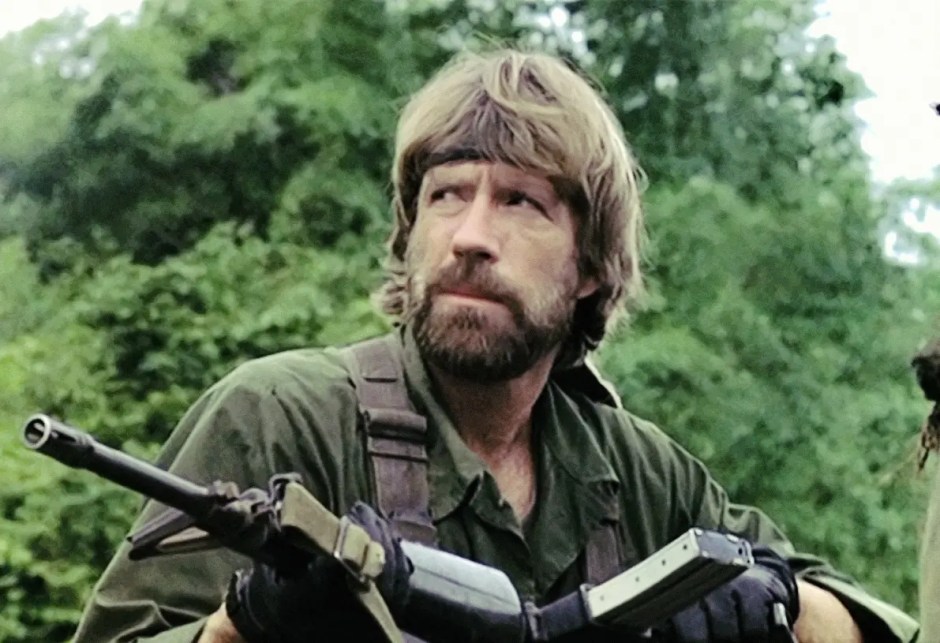
Next up is 1984’s Missing in Action, directed by Joseph Zito and starring Chuck Norris as Colonel James Braddock, a Vietnam veteran who survived years as a prisoner of war. When reports suggest that American soldiers are still being held captive, Braddock returns to Vietnam as part of an official investigation.
The government wants meetings and negotiations. Braddock, in true 80s action movie fashion, has another plan. Now I always enjoyed Missing in Action, partly because it sits right between a traditional war movie and the larger-than-life action movies that took over the decade. That combination also made it popular with my uncles. It had enough military hardware, jungle combat, and wartime history to feel like a war picture, but once Chuck Norris begins handling the mission himself, it becomes pure 1980s action.
Braddock is one of those perfect Norris characters. He’s quiet, haunted, and already ten steps ahead of everyone around him. He doesn’t spend much time explaining what he’s feeling because the beard is already handling most of the emotional exposition. Now the opening half gives the movie more weight than its reputation sometimes suggests. Braddock returns to the place where he was imprisoned, confronts officials who deny that American prisoners remain, and realizes that this official investigation is largely ceremonial. Then M. Emmet Walsh arrives as Jack Tucker, and the movie shifts gears. Walsh gives the movie some much-needed personality. And his worn-down humor gives Norris someone lively to play against.
As for the action, once Braddock launches the rescue mission, Joseph Zito keeps things moving with boats, gunfire, explosions, and Norris emerging from the water with a machine gun in a moment that probably sold half the VHS copies by itself. The first two Missing in Action movies were shot back-to-back, with the POW-camp story originally intended to be released first. Cannon decided the rescue film was more commercial, released it ahead of the other movie, and turned the original opening chapter into Missing in Action 2: The Beginning.
And it was the right call. Missing in Action earned roughly $22.8M domestically and helped cement Norris as one of Cannon’s most valuable stars. This was also one of those dependable video-store picks for me. When the newest releases were already gone, I knew Missing in Action was waiting for me. It was also a strong third selection during a rent-two-get-one-free deal. And every rental night needed that third tape. This was not necessarily the movie you went there to get, but it was a movie you knew would deliver once the pizza arrived.
Chuck Norris in Missing in Action gave Cannon a rescue mission with clear heroes, clear villains, and a satisfying destination. Our next rental on the other hand is nowhere near that comfortable. We’re leaving the battlefield behind and following Charles Bronson into one of the darker and more seedier corners of Cannon’s action catalog.
Kinjite: Forbidden Subjects (1989)
Next up is 1989’s Kinjite: Forbidden Subjects, directed by J. Lee Thompson and starring Charles Bronson as Lieutenant Crowe, a Los Angeles detective investigating a criminal operation built around the exploitation of teenage girls.
And when his case becomes connected to the disappearance of a powerful Japanese businessman’s daughter, it will naturally pull Crowe deeper into a violent and disturbing underworld few know of. Now Kinjite is an interesting film to discuss because the subject matter is much darker than the average Cannon action picture. This is not Charles Bronson defending a neighborhood, chasing a colorful criminal, or setting elaborate traps for a group of street punks.
The story deals with trafficking, assault, prejudice, and exploitation, and it handles those subjects with the blunt, and sometimes uncomfortable approach of a traditional late-80s Bronson thriller. I never rented this one during its original video-store life, but I remember catching pieces of it during cable rotation. It was one of those movies I knew of more through scattered scenes here and there in passing than through the full story. Later in the 1990s, I finally watched it from beginning to end and found myself enjoying it despite its obvious flaws. Bronson’s Crowe is an angry, exhausted character. He’s spent years looking at the ugliest parts of Los Angeles, and this case pushes him beyond whatever patience he had left. And when looking back I think Bronson was always effective at playing these conflicted character types.
The movie also tries to explore the cultural divide between Crowe and Hiroshi Hada, the Japanese businessman whose daughter has been taken. Some of these ideas are interesting, however the script also leans into stereotypes and attitudes that have aged poorly. So it makes this a movie that wants to criticize prejudice while occasionally getting tangled up in its own.
And, that contradiction ends up keeping Kinjite from being as thoughtful as it seems to believe it is. Regardless, the movie has a grim atmosphere, a strong Bronson performance, and the experienced hand of Thompson behind the camera. Thompson and Bronson had made several films together, including 10 to Midnight, Murphy’s Law, and Death Wish 4. This would be their ninth and final collaboration, as well as Thompson’s last feature film. And Kinjite may not be a traditional action crowd-pleaser. But as a late-period Bronson thriller, it has a grimy weight and enough nostalgic grit to entertain.
Now after that heavy handed stop, we need to move back toward the brighter, more wonderfully ridiculous end of the Cannon Films shelf. So bring back the headbands, dust off the throwing stars, and prepare for the movie that convinced an entire generation of kids that ninjas were hiding behind every tree in the neighborhood.

American Ninja (1985)
Next is 1985’s American Ninja, directed by Sam Firstenberg and starring Michael Dudikoff, Steve James. In this one Dudikoff plays Joe Armstrong, a quiet soldier stationed at an American military base in the Philippines. And when there’s an attack on an Army convoy, Joe suddenly reveals an expert command of ninjutsu, saves the commanding officer’s daughter, and attracts the attention of an arms dealer operating his own private ninja army. Because in 1985, every successful criminal organization needed a ninja division. Now, American Ninja was a routine watch for me. I loved ninjas as a kid, I planned on being a ninja as an adult, and this movie was the perfect combination of a ninja flick and the type of oversized action spectacle of movies like Commando.
It had martial arts, military action, explosions, secret compounds, corrupt officers, and enough ninja activity to make the backyard as a kid feel like an active combat zone. I remember wanting the movie on VHS for Christmas, but that tape never appeared under the tree.
So I did what any resourceful kid in the cable era would do. I bootlegged my own copy. Once it aired on cable, the family VCR did the rest of the work. And it may not have been the official release with the slip cover, but it was mine, and it received heavy rotation. You could routinely find me watching it in ninja pajamas, surrounded by homemade throwing stars and cardboard-tube swords. Fully prepared to defend the house.
I think Dudikoff works because Joe Armstrong is built around mystery. He barely speaks, remembers little about his past, and responds to danger with the mild annoyance of someone whose afternoon plans have been disrupted.
Dudikoff didn’t have formal martial-arts training when he was cast, but Sam Firstenberg and the stunt team designed the action around his athletic ability and screen presence. And I think this approach worked out great. But the movie’s real secret weapon is Steve James as Corporal Curtis Jackson. James brings charisma, humor, and genuine physical power. His early confrontation with Joe is one of the movie’s best moments, and once they become friends, Dudikoff and James turn into one of Cannon’s most enjoyable action teams.
Then there’s Tadashi Yamashita as the Black Star Ninja, a villain armed with gadgets, weapons, and the confidence of a man who bet the farm on himself to not living until the end credits. He’s totally over the top and perfect in his role as the heavy. Now American Ninja was made for roughly $1M, and it would earn around $10.5M domestically. It would also be the launch of a five-film franchise. And sure it’s not polished or remotely realistic, but it’s colorful, fast, sincere, and endlessly rewatchable whether you were a ninja-obsessed kid or not.
I hope you’re still with me because by 1985, Cannon had ninjas, soldiers, secret compounds, corrupt officers, and enough franchise potential to keep the video shelves stocked for years. But our final movie decided that one military base was not a large enough battlefield. This time, the entire country is under attack, and America’s last line of defense is Chuck Norris in a Canadian Tuxedo.

Invasion U.S.A. (1985)
Our final movie in tonight’s action lineup is 1985’s Invasion U.S.A., directed by Joseph Zito and starring Chuck Norris as Matt Hunter, a former CIA operative living a quiet life in the Florida Everglades. When Soviet terrorists launch a coordinated series of attacks across the United States, Hunter is pulled out of retirement to stop them.
I’ve loved Invasion U.S.A. since I was a kid. This was another dependable go-to movie when the tapes I originally wanted were already rented. And that’s not a slight against it. Invasion U.S.A. was always available, always turning up on cable, and always knew exactly what kind of movie it wanted to be. So going with Chuck Norris protecting America from international terrorists was a safe, satisfying choice for a big action movie night even on repeat.
The film takes Cold War paranoia and runs it through the full Cannon action assembly line. Terrorists infiltrate the country and begin attacking suburban neighborhoods, churches, shopping centers, school buses, and holiday gatherings. The goal is not simply military victory. Rostov, our Russian villain, wants to create fear and social collapse by making ordinary Americans believe that nowhere is safe. This gives the movie a surprisingly nightmarish edge, even when the action becomes completely outrageous. Now, Chuck Norris here is operating at maximum 1985 levels. Matt Hunter lives in the Everglades, wrestles alligators, wears double denim, drives a pickup truck, and speaks only when silence has stopped being sufficiently threatening.
Richard Lynch is equally important as Rostov. He has the sharp, haunted look of someone who’s been losing sleep over Matt Hunter for years. Which gives our hero-villain duo some rich history. Rostov commands an entire terrorist army, but every time Hunter appears, he reacts like a ghost has walked into the room.
Now as for the action Zito stages the set-pieces on a much larger scale than Missing in Action. Houses explode. Cars explode. Boats explode. Shopping malls explode. Even the air around Chuck Norris seems to have been soaked in gasoline. The climactic battle inside the shopping center is pure Cannon spectacle, ending with Hunter and Rostov facing each other with rocket launchers because ordinary firearms would’ve been too subtle. It’s ridiculous in the most magical of ways.
The movie reportedly cost around $12M and earned approximately $17.5M domestically. So it became the blockbuster Cannon hoped for, but it became one of the studio’s most recognizable action titles through cable and home video. Naturally, critics tore it apart, and the movie is unquestionably violent, excessive, paranoid, and ridiculous. But it is also memorable, practical, energetic, and fully committed to its premise. So, when the new-release wall at the video store was empty, Invasion U.S.A. never felt like settling.

And that wraps up Episode Five of our Cannon Films shelf dive. The All Action Edition. We watched Franco Nero become an unlikely ninja, sent Chuck Norris back into enemy territory, followed Charles Bronson through one of his darkest investigations, joined Michael Dudikoff and Steve James for some prime ninja action, and then watched Chuck return to personally save the entire United States. And to me that’s a pretty healthy Cannon marathon.
These five movies also represent several different kinds of video-store memories. Some were favorites you hunted down. Some became homemade cable recordings. Some were movies you slowly discovered through late-night television. And some were dependable backup rentals when everything on the new-release wall was already gone.
That was the beauty of the video store. You went in looking for one thing, wandered through the aisles, took a chance on something else, and occasionally came home with ninjas, Chuck Norris, and no regrets. Now I want to kick it back to you guys. Let me know in the comments which of these five you would have rented first.
Anthony J. Digioia II © 2026

SilverScreen Analysis & Sunset Video Rentals
