
Now back in the 80s some studios sold prestige. Some sold star power. New World Pictures I think you could say, sold possibility. This was a company where Godzilla could share shelf space with a futuristic supercar, a rock-star terrorist, two undead police officers, and Dolph Lundgren brooding in a sewer.
Their movies didn’t always have the biggest budgets or the cleanest production histories, but they had personality. They were action movies, horror movies, and strange combinations that could’ve only escaped from the laboratory of 1980s independent filmmaking. So tonight, we’re rewinding five movies from a studio that I think helped turn the neighborhood video store into a midnight movie factory.
What’s up, guys? Welcome back to Sunset Video. New World Pictures was founded in 1970 by Roger Corman and his brother Gene, and they operated outside the traditional Hollywood studio system. Under Corman, New World became known for making inexpensive genre films, distributing exploitation pictures, importing acclaimed foreign films, and giving young filmmakers opportunities they weren’t finding with the major studios. So that combination made New World difficult to categorize.
The same company associated with drive-in attractions and low-budget horror also distributed films from directors such as Ingmar Bergman, Federico Fellini, and Akira Kurosawa. So, behind the scenes, it became an unofficial training ground for future filmmakers such as Joe Dante, Jonathan Demme, Ron Howard, and James Cameron.
Corman sold New World Pictures in 1983, and the company began transforming quickly. The new owners expanded into television, international distribution, and home video while attempting to compete with larger studios through more ambitious theatrical releases, despite lacking the production scale to support them. In 1986, New World even acquired Marvel Entertainment Group, giving the company control of one of the largest collections of comic-book characters in the world. And the five movies in this episode come directly from that transitional era.
New World was no longer Roger Corman’s lean production company, but it wasn’t quite a traditional major studio either. It existed somewhere in the middle, taking recognizable stars, unusual concepts, imported properties, and occasionally questionable business decisions, then sending the results to theaters, video-store shelves, and late-night cable. It was a standard formula and our first movie tonight brought one of Eastern cinema’s biggest stars back to American screens. A star who stood more than 260 feet tall with atomic breath.
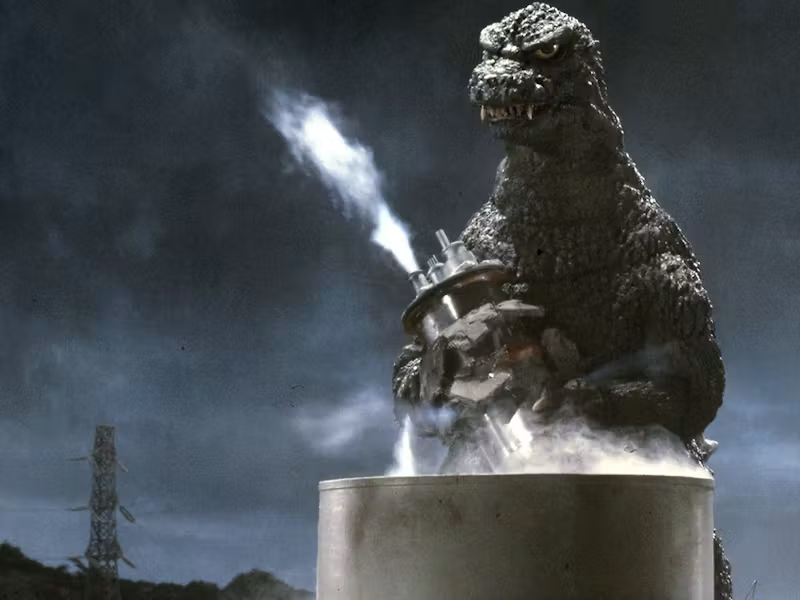
GODZILLA 1985 (1985)
After nearly a decade without a new Godzilla movie, Toho brought the character back with 1984’s The Return of Godzilla. The film ignored the previous sequels and positioned itself as a direct continuation of the original 1954 movie.
Here Godzilla was no longer the colorful defender of Earth who spent the ‘70s drop-kicking other monsters. He was once again presented as a walking natural disaster, drawn toward nuclear energy and capable of wiping out entire sections of Tokyo. New World had acquired the North American distribution rights and reshaped the film into Godzilla 1985. The company shortened and dubbed the Japanese version while filming additional American scenes featuring Raymond Burr, who reprised his role as reporter Steve Martin from the American edition of the original Godzilla.
Burr, a consummate professional, reportedly took the material seriously and resisted efforts to treat Godzilla strictly as a joke. That approach works: even when the New World version slips in some conspicuous Dr Pepper product placement, Burr’s presence gives the American footage an appropriately grave tone. This was the first Godzilla movie I remember watching, and as an eight-year-old, it felt closer to a horror film than a monster adventure. And the sequence aboard the abandoned fishing boat certainly didn’t help.
Before Godzilla even enters the story, the crew discovers a seemingly deserted vessel only to encounter these mutated sea creatures. It’s a grim, claustrophobic opening that announces immediately this is not the friendly Godzilla from Saturday-afternoon television. And that opening sequence has stuck with me since I was a kid. Even today, there’s something unsettling about the movie’s atmosphere. Godzilla moves through the city less like a character and more like an approaching storm. And sure, the human story can become heavy with military meetings and politically infused discussions, but that seriousness gives all the destruction a sense of weight.
Now as you can expect, the effects are occasionally uneven, particularly when the full-sized cybot version of Godzilla appears, but the miniature work remains impressive. Buildings collapse, streets burn, and Godzilla’s attack feels dangerous rather than playful.
Raymond Burr’s closing narration also gives the American version an unexpectedly mournful finish. It treats Godzilla not simply as a monster, but as a warning created by humanity’s own appetite for destruction. New World released Godzilla 1985 on August 23, 1985. It opened in only 235 theaters and earned just $4.1 million in the United States. That was not enough to restart the franchise in American theaters, but the movie found a much longer life through television broadcasts and VHS rentals, which is where I found it.
Because for an entire generation of younger viewers, this darker American version was their introduction to Godzilla. Now once New World had finished importing a giant nuclear monster, the company turned its attention towards another experimental machine. One that could fit inside a parking garage instead of being big enough to smash one.

BLACK MOON RISING (1986)
Released in January 1986, Black Moon Rising stars Tommy Lee Jones as Sam Quint, a professional thief working for the federal government. Quint steals an incriminating cassette tape from a corrupt corporation, but when the company’s security forces begin closing in, he hides the tape inside an experimental automobile called the Black Moon.
There’s just one small complication: the car is stolen before Quint can retrieve it, which leads him to Nina, played by Linda Hamilton, a professional car thief working for crime boss Ed Ryland, played by Robert Vaughn. Quint now has to recover the tape, expose the corporation, deal with the criminals hunting him, and somehow steal back a futuristic automobile locked inside a heavily guarded skyscraper.
Now the story actually originated with John Carpenter, who wrote an early version of the screenplay around the period when he was making Escape from New York. Carpenter described it as his “my car is stolen and I’m going to get it back” story, although the eventual screenplay would receive writing contributions from both William Gray and Desmond Nakano. The Black Moon itself was based on an actual Canadian prototype called the Wingho Concordia II. Now only one original prototype existed, so replicas and molded copies were constructed for the movie’s interior and for all the stunt work.
And in retrospect this was just one of those dependable cable movies for me. It was also exactly the kind of title you rented when the wall of New Releases had been picked clean. You might not have entered the store planning to rent Black Moon Rising, but Tommy Lee Jones, Linda Hamilton, and a futuristic car made for a persuasive backup plan nonetheless. Jones is perfectly suited to Sam Quint. He plays him as experienced, tired, and mildly irritated that everyone keeps making his job more difficult. Even this early in his career, Jones had that wonderful ability to make exposition delivery sound like a personal complaint.
Hamilton is equally strong as well. Nina could’ve been written as little more than the mysterious woman who complicates the hero’s mission, but Hamilton gives Nina confidence and an edge of vulnerability. She feels capable of surviving in the same world as Quint rather than simply being pulled through his story with him. So that’s a bonus.
Admittedly, the narrative connecting everything can become shaky. The stolen tape, the supercar, the corporate conspiracy, and Robert Vaughn’s criminal operation occasionally seem to belong to separate movies that were coincidentally parked in the same garage. But the individual pieces work well enough to keep the audience engaged. The break-ins are tense, the car chases have weight, and the final attempt to launch the Black Moon between two skyscrapers delivers exactly the kind of oversized finish promised by the flashy VHS cover.
Black Moon Rising opened on January 10, 1986, earning approximately $2.8 million during its opening weekend and around $6.6 million domestically. It wasn’t a major breakout, but it performed respectably for an unusual science-fiction action picture released during the quiet weeks of January, which has always been considered clearance month at the theater.
It also remains as a classic example of New World’s mid-80s identity: recognizable actors, a marketable hook, a slightly unruly screenplay, and enough practical action to keep the rental worthwhile. Now, one year later, the studio would return to the streets of Los Angeles. But this time around the vehicle was much less important than the man driving it.

WANTED: DEAD OR ALIVE (1987)
Released in the United States in January 1987, Wanted: Dead or Alive stars Rutger Hauer as Nick Randall, a former CIA operative working as a professional bounty hunter in Los Angeles. Randall is recruited by his former employers to track down international terrorist Malak Al-Rahim, played by Kiss frontman Gene Simmons. Al-Rahim has quietly entered the country, carried out a deadly theater bombing, and is planning an even larger chemical attack that Randall must stop.
So, on the surface, this is a straightforward late-’80s action thriller. The government needs a dangerous man captured. The officials know another dangerous man who can do it. He doesn’t trust them, they don’t particularly trust him, and everyone spends the next hundred minutes confirming those suspicions were all reasonable.
The movie also has a peculiar connection to television history. Nick Randall is identified as a descendant of Josh Randall, the bounty hunter played by Steve McQueen in the television series Wanted: Dead or Alive, which ran from 1958 through 1961. The harmonica and references to Nick’s grandfather connect the two characters, transforming the film into a modern continuation of the old television Western—an unusual idea that the movie introduces and then spends no time explaining.
This was also one of those films you could step into halfway through and continue watching without feeling completely lost. Because the structure is highly procedural. Randall gathers information, tracks suspects, pressures informants, checks weapons, and slowly tightens the net around Al-Rahim. There are no elaborate twists or complicated mythologies. It’s a meat-and-potatoes action thriller served with a side of Los Angeles smog.
But what elevates this thing is Rutger Hauer. Hauer could bring intelligence and unpredictability to characters who might have felt ordinary in another actor’s hands. Nick Randall is controlled, observant, and clearly capable of violence, but Hauer avoids turning him into a generic one-man army prototype. He gives the character a quiet sadness, particularly in the scenes involving his girlfriend and through his strained relationship with the government. Randall isn’t simply hunting Al-Rahim for a paycheck. And as the conflict becomes personal, the professional mask begins to crack and Hauer delivers the subtle character layering with ease.
I think Gene Simmons also makes an effective villain because he plays Al-Rahim with surprising restraint. The casting promises something theatrical, but Simmons keeps the performance cold, calculated, and controlled. The movie is undeniably a product of its time, especially in its depiction of international terrorism, but the confrontation between Hauer and Simmons gives it a harder edge than many comparable action films. And then there’s the ending. Randall’s final delivery of Al-Rahim is brutal, abrupt, and accompanied by one of the driest payment disputes in action-movie history. The closing is the moment most viewers remember, and it sends the movie out on exactly the right note.
Now Wanted: Dead or Alive opened on January 16, 1987, in just over one thousand theaters. It earned approximately $2.8M during its opening weekend and finished with roughly $7.6M domestically. So, it’s not a revolutionary action film, but it is a sturdy one. Hauer and Simmons turn a familiar procedural into a durable relic from the 80s action movie era. With Wanted: Dead or Alive, New World had successfully combined a television Western with a modern terrorist thriller. But for its next experiment, the company combined a buddy-cop movie with the living dead.
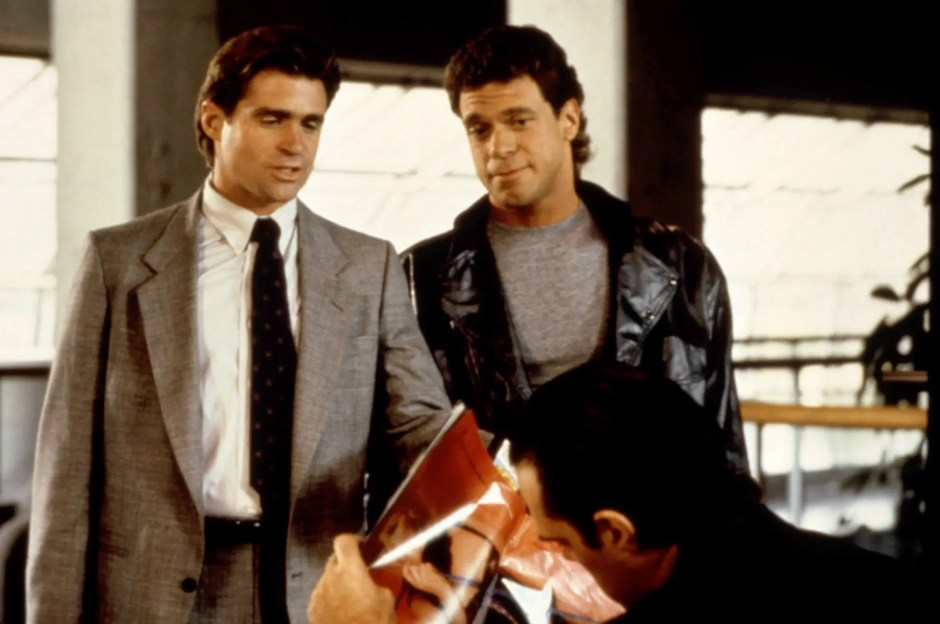
DEAD HEAT (1988)
By 1988, the buddy-cop formula was everywhere. So New World Pictures did the logical thing: it killed one of the cops in the duo.
Dead Heat stars Treat Williams and Joe Piscopo as Los Angeles detectives Roger Mortis and Doug Bigelow. While investigating a series of robberies committed by criminals who appear impossible to kill, Mortis discovers a laboratory that’s using advanced technology to reanimate the dead. Mortis is actually killed during the investigation, but his body is placed inside the resurrection machine. So, he returns to life but with only a limited amount of time before his body begins permanently decomposing. So, he pretty much needs to solve his own murder before his warranty expires.
Now this movie marked the feature directorial debut of Mark Goldblatt, an accomplished editor whose credits at the time already included The Terminator, Commando, and Rambo II. And that expansive editing background is visible throughout Dead Heat. The movie moves quickly, rarely allows the plot to settle, and treats tonal consistency as more of a friendly suggestion than a binding agreement. So, it’s an engaging ride despite its front and center absurdity.
This was one of the first real horror comedies I remember watching as a kid. Usually when it showed up during the weekend cable rotation. And really, above all, the silliness was the attraction. The premise is ridiculous, the dialogue knows it is ridiculous, and the performances commit to the material without attempting to make it respectable. Treat Williams gives the movie a surprisingly steady center, playing Mortis as a relatively normal detective who’s slowly realizing that he’s becoming a decomposing corpse.
Piscopo, on the other hand, goes in the opposite direction. Bigelow is loud, impulsive, and determined to flirt his way through every supernatural emergency. The chemistry between them should not work, but that contrast is exactly what gives the movie its peculiar rhythm. The supporting cast is another treasure chest of familiar faces. Vincent Price lends the entire production a little horror royalty, while Keye Luke, Robert Picardo, and Professor Toru Tanaka drift through the madness and leave an impression as well. The real stars, however, are the practical effects.
The sequence inside the Chinese butcher shop remains the movie’s grand display of rubber, slime, puppetry, and inspired bad taste. Dead chickens, animal carcasses, severed meat, and an extremely unhappy pig return to life in a scene that is equally disgusting and hilarious.
Screenwriter Terry Black was the older brother of Lethal Weapon writer Shane Black, who also appears briefly in the movie as a police officer. And Terry’s original screenplay began as a student writing project before eventually being purchased and produced. Dead Heat opened on May 6, 1988, earning approximately $1.7 million during its opening weekend. It finished its domestic run with about $3 million before disappearing from theaters fairly quickly, then found the audience it was always destined to meet on late-night cable and home video.
This movie’s messy, uneven, and frequently absurd. But it’s also one of the few films brave enough to ask what would happen if Lethal Weapon wandered into a zombie movie and neither production noticed until the butcher shop exploded. Mark Goldblatt’s experience on Dead Heat would actually lead directly into another New World production. The studio had recently acquired Marvel Comics, and it finally had an opportunity to bring one of those characters to the screen.

THE PUNISHER
Now long before interconnected universes, billion-dollar box-office runs, and post-credit scenes, there was Dolph Lundgren sitting alone beneath the streets of Sydney. Directed by Mark Goldblatt and produced through New World International, The Punisher stars Lundgren as Frank Castle, a former police officer believed to have died with his family.
Five years have passed, and Castle has become a vigilante operating from the sewer system, waging a private war against organized crime. When the Japanese Yakuza begins kidnapping the children of local Mafia families, Castle is forced into an uneasy alliance with the same criminals he’s spent years executing. The movie also stars Louis Gossett Jr. as Castle’s former partner, Jeroen Krabbé as Mafia boss Gianni Franco, and Kim Miyori as Yakuza leader Lady Tanaka. It really is a relic of its time: an unusually grim comic-book movie, especially when viewed beside the bright superhero films that would follow.
When I first watched it as a kid, the relentless doom and gloom sort of felt slightly out of balance considering the smaller serving of action the movie delivered. Frank Castle spends much of the story alone, wounded, exhausted, and delivering internal monologues from the floor of an underground hideout. So there’s very little superhero fantasy here to chew on.
It plays more like a bleak vigilante thriller wearing the faint outline of a comic-book adaptation. But as I’ve gotten older, I’ve come to appreciate that approach a bit more. Lundgren looks genuinely haunted. He doesn’t play Castle as a charismatic action hero waiting for the next set piece. This version of Frank really does seem like a man who stopped living when his family died and simply forgot to lie down with them.
Now the movie does remain flawed. The pacing can drag, the Yakuza storyline occasionally veers toward excess, and Castle’s sewer dwelling makes one wonder whether the Punisher’s greatest enemy might actually be a serious respiratory infection. And yes, a huge miss was the decision to remove the character’s famous skull emblem, a choice that remains baffling. Goldblatt would later express regret about its absence, although the filmmakers initially believed a more stripped-down, utilitarian look would better suit the movie’s tone.
Regardless, the film delivers some strong action sequences. The casino attack, the bus ambush, and the final assault on Lady Tanaka’s headquarters are violent and efficiently staged. And Lundgren handles the physical material well, while Gossett gives the story an emotional connection to Castle’s former life.
Now the most interesting box-office fact about this one is that The Punisher never received its planned wide theatrical release in the United States. The film opened theatrically in several international markets beginning in 1989, but New World’s worsening financial problems derailed its American launch. The U.S. distribution rights were eventually sold, and the movie would arrive quietly on VHS and LaserDisc in April 1991.
So, for many American viewers, the first live-action Punisher movie didn’t appear beneath a theater marquee. It appeared on a video-store shelf out of nowhere. And in retrospect, that feels entirely appropriate for the type of movie it is. It may not be the most faithful version of the character, and it certainly is not the polished Marvel production audiences would expect today. But as a late-’80s New World Pictures action film, it has a grizzled exterior and an even grittier core, which is what makes it more interesting with age.
It’s a comic-book movie from a period when Hollywood had not yet figured out what such movies were supposed to look like, and that uncertainty is part of its charm.
And that’s it for today guys. Five movies. Five completely different corners of the video store. A Japanese monster resurrected for American audiences. A futuristic car carrying stolen evidence. Rutger Hauer hunting Gene Simmons across Los Angeles. Two detectives discovering that death is only a temporary admin problem. And Dolph Lundgren bringing one of Marvel’s darkest anti-heroes to life before superhero movies had a reliable blueprint.
And truly, that variety is what makes the New World Pictures library so fascinating to revisit. The movies were not always polished. Sometimes the stories wobbled, the budget limitations showed, or the business behind the scenes became more dramatic than anything appearing on camera.
But New World understood the power of a strong concept and an unforgettable VHS cover. Its films offered something slightly different from the major studios. They were darker, stranger, scrappier, and often willing to combine genres that probably should’ve remained in separate sections of the store.
And decades later, those imperfections have become part of their identity. Now I want to hear from you. Which of these five movies would’ve been your Friday-night rental, and what New World Pictures title should be pulled from the shelf for Volume 2 in this series?
Anthony J. Digioia II © 2026

SilverScreen Analysis & Sunset Video Rentals